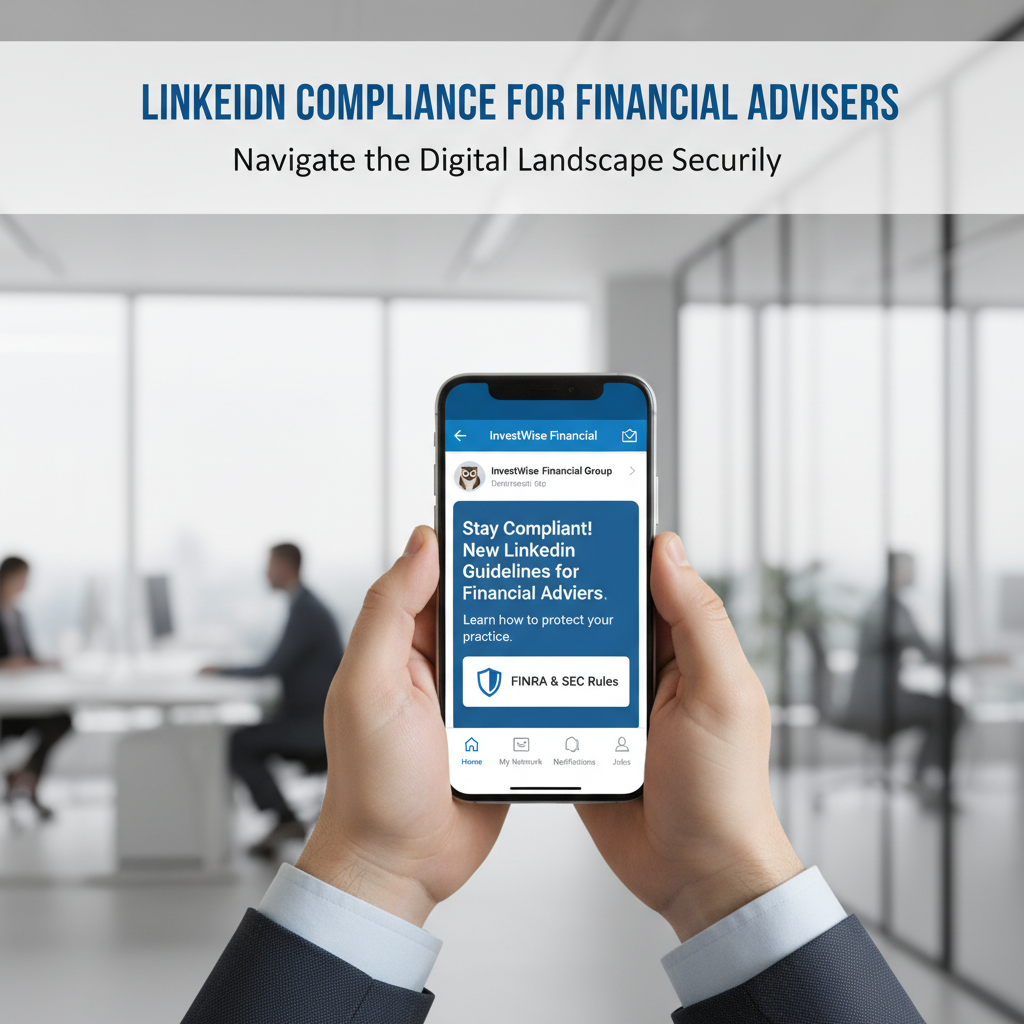
How to Post on LinkedIn as a Financial Adviser Without Getting Fined
LinkedIn has become the default marketing channel for financial advisers in the UK. It makes sense. Your clients are there. Your referral sources are there. The platform rewards professional content. And unlike Instagram or TikTok, nobody expects you to dance.
But LinkedIn's professional veneer creates a false sense of security. Advisers who would never dream of putting an unregulated claim in a newspaper ad will happily post something equivalent on LinkedIn without a second thought. The informality of the platform makes people forget they're still operating under the same regulatory framework.
The FCA doesn't distinguish between a glossy magazine advertisement and a LinkedIn post. Both are potentially financial promotions. Both need to comply with the same rules. And both can get you fined.
So how do you actually use LinkedIn effectively without crossing the line?
Why LinkedIn Specifically Matters
LinkedIn is unique among social media platforms for financial advisers for a few reasons.
First, the audience is self-selecting for financial decision-makers. High earners, business owners, professionals approaching retirement. These are exactly the people who might act on financial content they see. That makes your posts more likely to be classified as financial promotions, because the audience is more likely to be influenced by them.
Second, LinkedIn content has a long shelf life. Posts can surface in feeds weeks or months after publication. That evergreen quality is great for reach but creates an ongoing compliance obligation. A non-compliant post from six months ago is still non-compliant today, and it's still visible.
Third, LinkedIn blurs the line between personal opinion and professional advice. The platform encourages "thought leadership" and personal storytelling. Both are fine in principle, but when a regulated professional shares a personal view on investment strategy, the FCA doesn't see a personal opinion. They see a financial promotion from an authorised person.
The Content That Causes Problems
Let me walk through the types of LinkedIn posts that consistently create compliance issues for financial advisers.
The humble brag
"Just completed a complex pension transfer for a client, saving them £45,000 in unnecessary charges. Love helping people take control of their financial future!"
This is everywhere on LinkedIn and almost always non-compliant. You've made a specific financial claim (£45,000 saved), implied that pension transfers are beneficial (they're not always), potentially breached client confidentiality, and there's not a risk warning in sight.
The market commentary that becomes a recommendation
"Markets have corrected 15% this quarter. History tells us that buying during corrections produces the best long-term returns. Is it time to top up your ISA?"
You started with factual commentary and ended with what amounts to investment advice directed at a mass audience. The implied recommendation to invest during a downturn, combined with a direct question encouraging action, makes this a financial promotion that needs risk warnings, balance, and proper disclaimers.
The testimonial
"Wonderful review from one of our clients! 'Working with [firm] has been brilliant. My pension has grown 30% in two years and I feel confident about retiring early.'"
Client testimonials involving specific outcomes are a minefield. The FCA's rules on testimonials in financial promotions are strict. Performance claims need context, risk warnings, and can't be cherry-picked. This post fails on all counts.
The engagement bait
"POLL: What's the biggest financial mistake people make? A) Not starting a pension early enough B) Paying too much in fees C) Not getting professional advice"
Seems harmless. But every option subtly pushes towards engaging a financial adviser. That's inducement. It's soft, but it's there. And the FCA looks at the overall impression, not just the explicit message.
The scary statistic
"Did you know that 38% of UK adults don't have enough saved for retirement? Don't let that be you. Take action now."
Fear-based content that pushes towards action without balanced information. Under Consumer Duty, this kind of post fails the consumer understanding outcome because it creates anxiety without providing the context someone would need to make a good decision.
A Step-by-Step Process for Compliant Posting
Here's what I'd suggest as a practical workflow.
Step 1: Write your post naturally. Don't self-censor at this stage. Get the message down the way you want to say it.
Step 2: Classification. Ask yourself: could a reasonable person interpret this as encouragement to engage in financial activity? If your post mentions specific products, services, performance figures, or outcomes, the answer is almost certainly yes. If it's genuinely just personal news or industry commentary without any call to action, you might be fine.
Step 3: If it's a financial promotion, add the required elements.
- Risk warnings appropriate to the product or service mentioned
- A disclaimer identifying your firm and its regulatory status
- Balanced information (if you mention benefits, acknowledge risks)
- Clear language that your target audience can understand
Step 4: Consumer Duty sense check. Read the post as if you're a potential client who knows nothing about financial services. Would you understand it? Could you make a poor decision based on it? Does it support good outcomes?
Step 5: Record and approve. Save a copy of the post with the date and who approved it. If you're a sole trader, document that you've done the review. If you're in a firm with a compliance function, get it signed off.
Step 6: Monitor after posting. Check for comments and questions. Respond appropriately, directing detailed queries to proper advice channels.
Before and After Examples
Let's rework some common post types.
Pension content
Before: "The pension lifetime allowance is gone. This is the biggest opportunity for high earners to supercharge their retirement savings. Max out your contributions while you can!"
After: "With changes to the pension lifetime allowance, the rules around pension contributions have shifted significantly. For some higher earners, this could change how they approach retirement planning. But the right strategy depends on your complete financial picture, including other assets, income needs, and tax position. Pension values can go down as well as up. Tax treatment depends on individual circumstances and may change. Worth reviewing with a qualified adviser if your circumstances have changed."
Market update
Before: "What a quarter! Our portfolios are up 8% while the FTSE is flat. Proof that active management works. Get in touch to find out how we can help you."
After: "Q1 market review: It's been an interesting quarter across global markets. Different asset classes and strategies have performed very differently, which is a good reminder of why diversification matters. Past performance doesn't guarantee future results. If you'd like to understand how market conditions might affect your financial plan, we're always happy to have a conversation. [Firm name], authorised and regulated by the FCA (FRN XXXXXX). Capital at risk."
Personal story
Before: "A client called me today in tears of happiness. She can now retire five years early thanks to our advice. This is why I do what I do."
After: "One of the most rewarding parts of financial planning is helping people feel confident about their future. Retirement planning looks different for everyone, and what works depends entirely on individual circumstances. If you're thinking about your retirement timeline, it's worth getting a clear picture of where you stand. [Firm name], authorised and regulated by the FCA."
Less exciting? Probably. Less likely to result in a regulatory problem? Definitely.
Don't Forget Your Profile
Your LinkedIn profile itself can be a financial promotion. Most advisers never think about this.
If your headline says "Helping professionals build wealth and retire early" that's arguably a financial promotion. It's an inducement to engage with financial services.
Your "About" section, if it includes claims about outcomes or performance, needs the same treatment as any other promotion.
Even your recommendations section can be problematic if clients have left reviews mentioning specific financial outcomes.
Review your entire profile through a compliance lens. Make sure your regulatory status is clearly visible. Include your firm name and FCA registration number somewhere prominent.
Building a Sustainable LinkedIn Presence
The advisers who do LinkedIn well in a compliant way tend to share a few characteristics.
They focus on education over promotion. Explaining how ISAs work is different from telling people to open one. Teaching people about the tax implications of pension withdrawals is different from encouraging them to withdraw.
They share their process, not their results. Talking about how you approach financial planning is safer and often more engaging than talking about what you've achieved for clients.
They're generous with general knowledge and careful with specific recommendations. You can share a lot of useful information without crossing into advice territory.
They use tools to help. Running every post through a compliance check before publishing becomes second nature. Something like PostGuard does this automatically against FCA rules, which means you spend less time worrying and more time creating useful content for your audience.
The Bigger Picture
LinkedIn is a brilliant platform for financial advisers. It drives referrals, builds credibility, and creates relationships that turn into clients. None of that requires you to cut corners on compliance.
Think of it this way: the advisers who get this right build a reputation for trustworthiness. The ones who don't, eventually build a reputation for something else entirely.
The FCA is watching. But more importantly, your potential clients are watching. And they're more sophisticated than you might think. A post that feels salesy or too good to be true won't just attract regulatory attention. It'll put off exactly the kind of clients you want to work with.
Compliance isn't the enemy of good marketing. Sloppy compliance is the enemy of good marketing. Get the foundations right and LinkedIn becomes one of the most effective tools in your business.